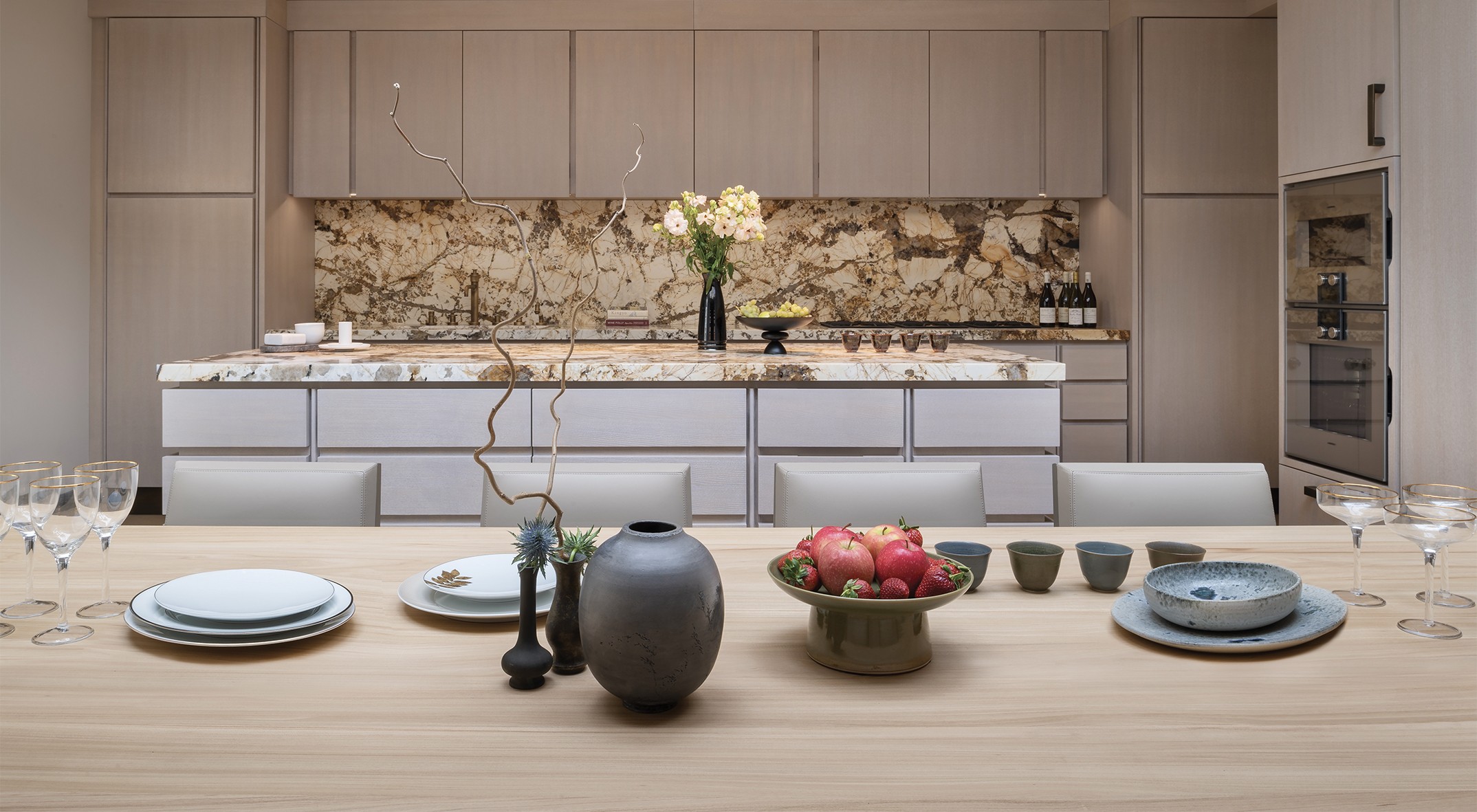
© Promemoria
Beyond the Visual: The Strategic Role of Scent in High-End Interior Design
Author
Published on
Niccolò Lissoni | niccolissoni
In contemporary design discourse, the emphasis on visual language has reached a point of saturation. Forms, materials, and compositions are no longer sufficient on their own to define truly distinctive environments. Increasingly, the most advanced projects are engaging with a more complex dimension: the orchestration of perception. Among these, scent remains one of the least explored—and most powerful—tools.
The recent emergence of spaces such as the Xuelei Fragrance Museum highlights a growing interest in olfactory experience within architecture. Yet beyond the conceptual narrative, a more relevant question arises:
What is the real role of fragrance in high-end design?
From Atmosphere to Strategy
Scent has long been associated with ambiance—something intangible, often treated as an accessory rather than a design component. In high-value environments, however, this perception is shifting. Fragrance is increasingly understood as:
a tool for spatial identity;
a mechanism for emotional anchoring;
a medium capable of shaping memory and perception over time.
Unlike visual elements, scent operates subconsciously. It does not demand attention—it defines presence. This makes it particularly relevant in sectors where experience is central.
The Risk of Superficiality
Despite its potential, olfactory design is often approached superficially.
Standardized “signature scents”, diffused uniformly across spaces, risk producing environments that are interchangeable, detached from context, and lacking authenticity.
In these cases, fragrance becomes a branding tool rather than a design instrument—flattening rather than enriching the spatial experience. This reflects a broader issue within certain strands of contemporary design: a tendency toward aestheticization without depth, where sensory elements are layered without true integration.
Toward a More Refined Approach
A more meaningful use of scent requires the same rigor applied to materials, light, and spatial composition. Fragrance must be:
contextual → aligned with architecture and function;
measured → never overpowering or intrusive;
evolving → capable of responding to time, use, and atmosphere.
In this sense, olfactory design becomes part of a broader project narrative, rather than an isolated gesture.
The question is no longer “which scent to use”, but:
What should this space feel like over time?
The Italian Perspective: Sensibility and Restraint
Within the Italian design tradition, sensory richness has always been present—but rarely explicit. Materials such as wood, leather, stone, and textiles inherently carry olfactory qualities. Their natural scents contribute subtly to the identity of a space, without the need for artificial enhancement. This approach reflects a broader cultural attitude:
preference for implicit sophistication over overt effect;
emphasis on material authenticity;
attention to balance and proportion.
In this context, fragrance is not added—it is revealed. For high-end interiors, this principle remains highly relevant. Rather than imposing a scent, the objective becomes to:
enhance existing material qualities;
create continuity between tactile and olfactory perception;
avoid sensory dissonance.
Fragrance as a Layer of Craft
When approached correctly, olfactory design aligns closely with craftsmanship.
Just as a bespoke piece of furniture is tailored to a space, a scent can be developed specifically for a project, calibrated in intensity and diffusion, or integrated into architectural elements. This requires collaboration between designers, perfumers, and material specialists.
A process that mirrors the logic of bespoke production.
Applications in High-End Projects
In luxury environments, the integration of scent can operate at multiple levels:
Hospitality
Subtle scent signatures can define arrival sequences, transitions between spaces, and moments of pause—without overwhelming the guest experience.
Retail
Olfactory identity can reinforce brand positioning, but must remain coherent with materials, lighting, and spatial narrative.
Private Residences
Here, the approach becomes even more nuanced—fragrance shifts from branding to intimacy, reflecting personal habits and rhythms.
In all cases, the key lies in control and coherence.
Design, Procurement, and Sensory Integration
The integration of scent into a project cannot be improvised. It requires coordination between design intent, technical systems (diffusion, HVAC integration), material selection, and operational management. This is where an integrated approach—combining design, consultancy, and procurement—becomes essential.
Fragrance, like any other component, must be tested, calibrated, and maintained over time. Without this level of control, even the most refined concept risks becoming inconsistent in execution.
Toward a More Conscious Luxury
In contemporary high-end design, luxury is increasingly defined by depth rather than excess. The use of scent, when approached with rigor, contributes to this evolution:
it enriches experience without adding visual noise;
it creates memory without imposing itself;
it enhances identity without resorting to cliché.
However, this requires discipline: not every space needs a scent. Not every concept benefits from sensory layering.
The true sophistication lies in knowing when to introduce fragrance—and when to rely on the inherent qualities of materials and space.
An Invisible Dimension of Design
Scent remains an invisible dimension—yet one of the most enduring.
It cannot be documented in drawings, nor fully captured in images. And precisely for this reason, it represents a frontier for design practices capable of operating beyond the purely visual.
In this territory, the value of expertise becomes the ability to integrate sensory elements into a coherent, refined, and technically controlled project.
Ultimately, the most memorable spaces are not only seen. They are experienced—subtly, deeply, and over time.
YOU MAY ALSO WANT TO READ
Culture
Apr 20, 2026
Luxury Across Markets: How Cultural Context Redefines the Meaning of Luxury
An analysis of how luxury is interpreted across China, Europe, and the United States, and why cultural context is essential for high-end design, procurement, and international market positioning.

Culture
Apr 18, 2026
Supply Chains Under Pressure: What the Strait of Hormuz Reveals About the Future of Construction
How disruptions in the Strait of Hormuz are reshaping global supply chains and why resilience, procurement strategy, and material flexibility are becoming critical in high-end construction.