© Promemoria
BluBluBlu: A Different Kind of Quiet at Milan Design Week 2026
Author
Published on
Niccolò Lissoni | niccolissoni
Installations grow more immersive, narratives more elaborate; and yet, in many cases, what remains after the initial impact is limited: an image, a color, a gesture—rarely a lasting idea.
At every edition of the Milan Design Week, a recurring question resurfaces:
How much of what we see is truly design, and how much is simply visual noise?
Within this landscape, the presentation of the BluBluBlu collection by Promemoria and Bottega Ghianda offers a markedly different position.
The Year of Blue
The 2026 collection revolves around a simple premise: blue—not as a trend, but as a material of thought. Rather than using color as surface, the collection constructs a chromatic narrative rooted in:
calm
depth
continuity
reflection
From pale sky tones to deeper, almost lacustrine hues, blue becomes a medium through which space is slowed down and recalibrated.
In a context where design is often driven by immediacy, choosing restraint becomes a form of positioning. The reference to a more contemplative approach—echoing the idea of emotion shaped over time—introduces a subtle but important shift:
Design is something to be experienced, not consumed.
Between Object and Architecture
One of the most relevant aspects of the Blu collection lies in its treatment of furniture not as isolated pieces, but as micro-architectures.
Take Delfi, for instance: a cabinet conceived as a “space within a space”, structured like a portal framing a suspended volume. This is not simply a storage element: it behaves as a spatial device, defining presence, light, and hierarchy within the room.
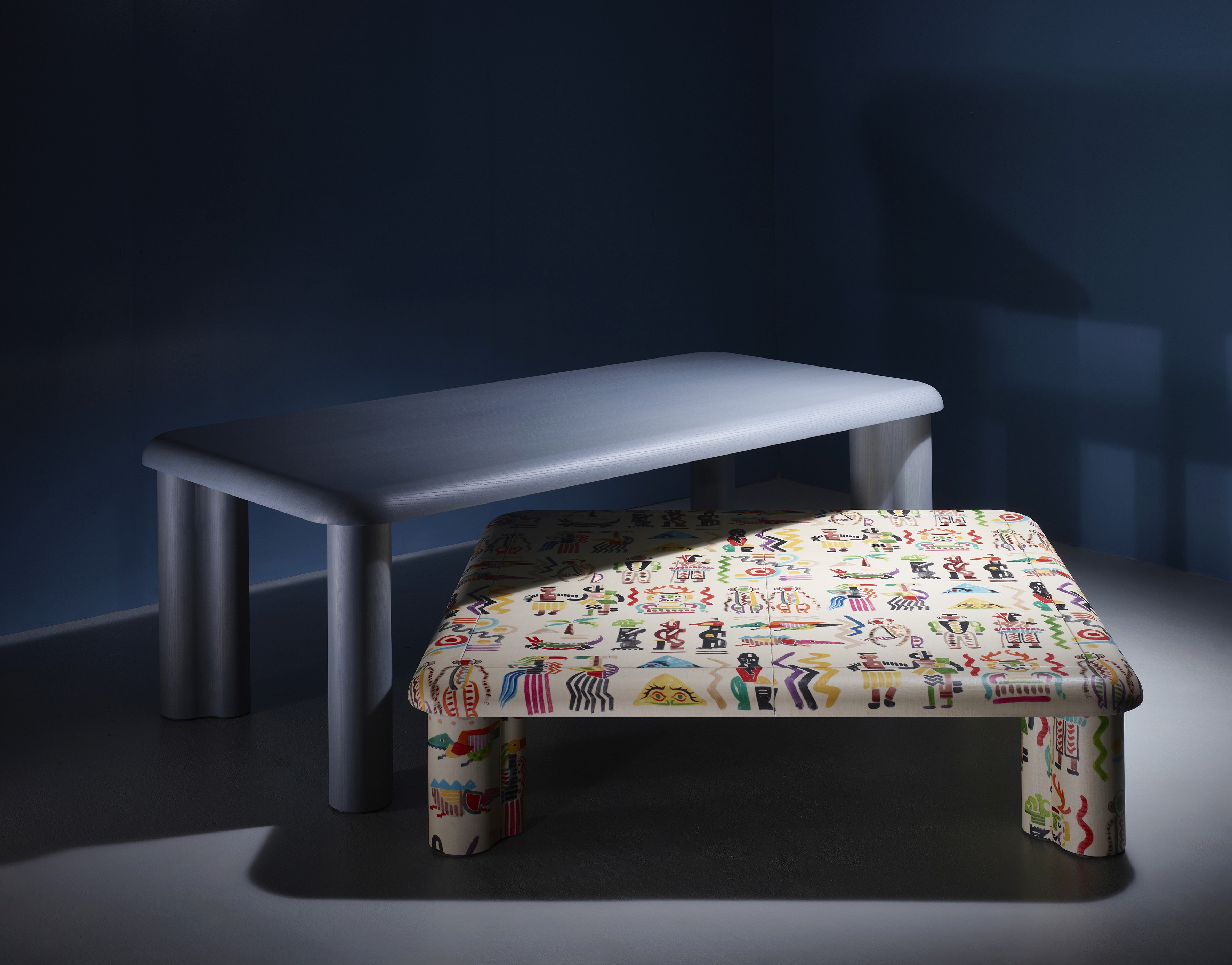
Similarly, the Adone dining table moves beyond typology. Its sculptural base, generated through interlocking geometries, transforms wood into a plastic, almost fluid material.
What emerges is not just a table, but a structural gesture balancing mass and lightness.
This approach reflects a broader principle:
Objects do not fill space—they construct it.
Movement, Transformation, Use
Another underlying theme across the collection is movement as functional fluidity.
The Zazà table introduces rotating leather trays, transforming a static object into an interactive element.
Even Ovidio, in its dual interpretation—wood or fully upholstered—embodies transformation, echoing the idea of shifting identities through material expression.
These gestures may appear subtle, but they address a fundamental issue often overlooked in contemporary design: how objects are actually used over time.
Craftsmanship as Structure, Not Decoration
Craftsmanship is not ornamental: it is structural. Layered wood veneers are milled to create depth rather than pattern; leather is not applied—it defines volume and tactility.
This is particularly evident in pieces such as Partenope, where the bronze backrest becomes an organic, almost coral-like structure; Lucemuta, developed with SO-LE Studio and Maria Sole Ferragamo, where light is filtered through material rather than projected into space; and Atena, where leather is treated with a bas-relief technique, reinforcing its architectural presence.
Collaboration as Cultural Dialogue
The Milan presentation also highlights a series of collaborations that extend beyond stylistic variation.
The partnership with Marcel Wolterinck introduces a more restrained, northern European sensibility, particularly visible in the Laren collection, where clean lines meet the density of Italian materials. Rather than diluting identity, these collaborations reinforce it, positioning Italian craftsmanship within a broader, international dialogue. They reflect a model where local excellence is preserved, global sensibilities are integrated, and design becomes a platform for cultural translation.
A Slower Form of Innovation
If there is a unifying aspect to the BluBluBlu collection, it is its pace: there is no urgency to impress, there is no need to declare innovation through excess. Instead, innovation is embedded in:
proportion
material logic
construction detail
usability
This does not make the collection less contemporary: on the contrary, it positions it outside the cycle of immediate obsolescence.
What Remains After the Week Ends
When the intensity of Milan Design Week fades, most installations disappear, and many objects lose their relevance outside the context that framed them. In the case of BluBluBlu, what remains is not a visual memory, but a methodology:
Design is rooted in material.
Objects are conceived as architecture.
Craftsmanship is used as structure.
Innovation is measured through use.
In a moment where design often oscillates between spectacle and abstraction, this approach suggests a quieter, more enduring direction: not less ambitious, simply more precise.
YOU MAY ALSO WANT TO READ

Culture
Aug 30, 2026
Lake Como: A Refined Journey Through Beauty, Culture, and Timeless Elegance
Discover Lake Como through its historic villas, literary heritage, architecture, gardens, and landscapes, from Lecco and Bellagio to Como, Cernobbio, and Tremezzina.

Culture
Aug 10, 2026
Genoa & the Cinque Terre: Architectural Heritage, Hidden Details, and Vertical Landscapes
Explore Genoa and the Cinque Terre through architecture, material culture, hidden details, and landscapes shaped by centuries of craftsmanship, adaptation, and local identity.